
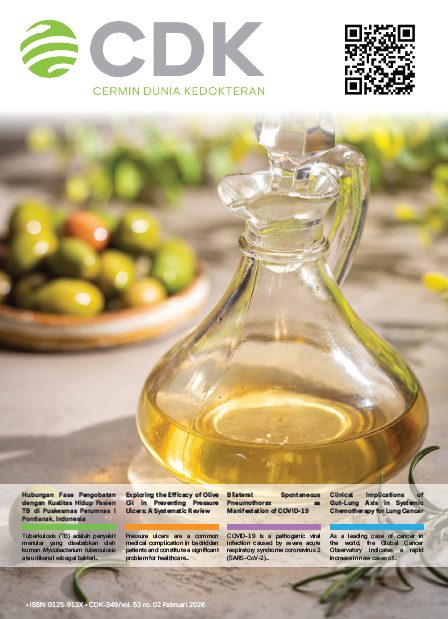
Implikasi Klinis Axis Usus-Paru dalam Kemoterapi Sistemik untuk Kanker Paru-paru
Tinjauan Pustaka
DOI:
https://doi.org/10.55175/cdk.v53i02.1699Kata Kunci:
Kemoterapi, aksis usus–paru, kanker paru, mikrobiotaAbstrak
Insiden kanker paru terus meningkat secara global dengan angka mortalitas yang diperkirakan mencapai 18% di seluruh dunia. Penatalaksanaan kanker paru saat ini berfokus pada skrining dini, terapi dini, dan perawatan paliatif. Namun, pendekatan yang lebih mendasar masih diperlukan untuk meningkatkan luaran pengobatan. Aksis usus–paru menjadi salah satu fokus penting karena berperan dalam pertahanan sistem paru dan dipengaruhi oleh perubahan mikrobiota usus dan paru. Perubahan komposisi mikrobiota telah ditemukan
pada pasien kanker paru dan diduga berkontribusi terhadap progresivitas penyakit. Kemoterapi sistemik, selain menargetkan sel kanker, juga memberikan efek sistemik yang dapat mengganggu keseimbangan mikrobiota usus dan paru, sehingga menyebabkan disbiosis. Kondisi ini berpotensi memengaruhi respons terapi, modulasi imun, dan luaran klinis pasien kanker paru. Ulasan ini membahas peran aksis usus–paru
dalam kanker paru serta dampak kemoterapi sistemik terhadap mikrobiota usus dan paru. Pemahaman mengenai interaksi ini diharapkan dapat membuka peluang strategi adjuvan untuk meningkatkan keberhasilan terapi dan kualitas hidup pasien.
Unduhan
Referensi
Bray F, Ferlay J, Soerjomataram I, Siegel RL, Torre LA, Jemal A. Global cancer statistics 2018: GLOBOCAN estimates of incidence and mortality worldwide for 36 cancers in 185 countries. CA Cancer J Clin. 2018;68(6):394–424. https://doi.org/10.3322/caac.21492.
Sung H, Ferlay J, Siegel RL, Laversanne M, Soerjomataram I, Jemal A, et al. Global cancer statistics 2020: GLOBOCAN estimates of incidence and mortality worldwide for 36 cancers in 185 countries. CA Cancer J Clin. 2021;71(3):209–49. https://doi.org/10.3322/caac.21660.
Thandra KC, Barsouk A, Saginala K, Aluru JS, Barsouk A. Epidemiology of lung cancer. Contemp Oncol (Pozn). 2021;25(1):45-52. https://doi.org/10.5114/wo.2021.103829.
PDQ Screening and Prevention Editorial Board. Lung cancer prevention (PDQ®): health professional version. In: PDQ Cancer Information Summaries [Internet]. 2002 [cited 2024 Oct 4]. Available from: http://www.ncbi.nlm.nih.gov/books/NBK66017/.
Midthun DE. Early detection of lung cancer. F1000Res. 2016;5(F1000 Faculty Rev):739. https://doi.org/10.12688/f1000research.7313.1.
Haryati H, Rahmawaty D, Wanahari TA. Implementing palliative and end-of-life care in lung cancer: when to start? J Respirasi. 2023;9(1):64–71. https://doi.org/10.20473/jr.v9-I.1.2023.64-71.
Indari A, Rasmin M, Syam AF. Gut-lung axis. Respir Sci. 2023;3(2):132–43. https://doi.org/10.36497/respirsci.v3i2.68.
Zhang D, Li S, Wang N, Tan HY, Zhang Z, Feng Y. The cross-talk between gut microbiota and lungs in common lung diseases. Front Microbiol. 2020;11:301. https://doi.org/10.3389/fmicb.2020.00301.
Wang J, Li F, Tian Z. Role of microbiota on lung homeostasis and diseases. Sci China Life Sci. 2017;60(12):1407–15. https://doi.org/10.1007/s11427-017-9151-1.
Zhao Y, Liu Y, Li S, Peng Z, Liu X, Chen J, et al. Role of lung and gut microbiota on lung cancer pathogenesis. J Cancer Res Clin Oncol. 2021;147(8):2177–86. https://doi.org/10.1007/s00432-021-03644-0.
Jin Y, Dong H, Xia L, Yang Y, Zhu Y, Shen Y, et al. The diversity of gut microbiome is associated with favorable responses to anti-programmed death 1 immunotherapy in Chinese patients with NSCLC. J Thorac Oncol. 2019;14(8):1378–89. doi: 10.1016/j.jtho.2019.04.007.
Daillere R, Vetizou M, Waldschmitt N, Yamazaki T, Isnard C, Poirier-Colame V, et al. Enterococcus hirae and Barnesiella intestinihominis facilitate cyclophosphamide-induced therapeutic immunomodulatory effects. Immunity 2016;45(4):931–43. doi: 10.1016/j.immuni.2016.09.009.
Charlson ES, Bittinger K, Haas AR, Fitzgerald AS, Frank I, Yadav A, et al. Topographical continuity of bacterial populations in the healthy human respiratory tract. Am J Respir Crit Care Med. 2011;184(8):957–63. https://doi.org/10.1164/rccm.201104-0655OC.
Apostolou P, Tsantsaridou A, Papasotiriou I, Toloudi M, Chatziioannou M, Giamouzis G. Bacterial and fungal microflora in surgically removed lung cancer samples. J Cardiothorac Surg. 2011;6:137. https://doi.org/10.1186/1749-8090-6-137.
Morris A, Beck JM, Schloss PD, Campbell TB, Crothers K, Curtis JL, et al. Comparison of the respiratory microbiome in healthy nonsmokers and smokers. Am J Respir Crit Care Med. 2013;187(10):1067–75. doi: 10.1164/rccm.201210-1913OC.
Hilty M, Burke C, Pedro H, Cardenas P, Bush A, Bossley C, et al. Disordered microbial communities in asthmatic airways. PLoS One. 2010;5(1):e8578. doi: 10.1371/journal.pone.0008578.
Beck JM, Young VB, Huffnagle GB. The microbiome of the lung. Transl Res. 2012;160(4):258–66. doi: 10.1016/j.trsl.2012.02.005.
O’Dwyer DN, Dickson RP, Moore BB. The lung microbiome, immunity, and the pathogenesis of chronic lung disease. J Immunol. 2016;196(12):4839–47. doi: 10.4049/jimmunol.1600279.
Marsland BJ, Gollwitzer ES. Host-microorganism interactions in lung diseases. Nat Rev Immunol. 2014;14(12):827–35. doi: 10.1038/nri3769.
Erb Downward JR, Falkowski NR, Mason KL, Muraglia R, Huffnagle GB. Modulation of post-antibiotic bacterial community reassembly and host response by Candida albicans. Sci Rep. 2013;3:2191. doi: 10.1038/srep02191.
Lloyd CM, Marsland BJ. Lung homeostasis: influence of age, microbes, and the immune system. Immunity. 2017;46(4):549–61. doi: 10.1038/srep02191.
Zeng W, Zhao C, Yu M, Chen H, Pan Y, Wang Y, et al. Alterations of lung microbiota in patients with non-small cell lung cancer. Bioengineered. 2022;13(3):6665–77. doi: 10.1080/21655979.2022.2045843.
Eftekhari R, de Lima SG, Liu Y, Mihara K, Saifeddine M, Noorbakhsh F, et al. Microenvironment proteinases, proteinase-activated receptor regulation, cancer, and inflammation. Biol Chem. 2018;399(9):1023–39. doi: 10.1515/hsz-2018-0001.
Van Spaendonk H, Ceuleers H, Witters L, Patteet E, Joossens J, Augustyns K, et al. Regulation of intestinal permeability: the role of proteases. World J Gastroenterol. 2017;23(12):2106–23. doi: 10.3748/wjg.v23.i12.2106.
Gowing SD, Chow SC, Cools-Lartigue JJ, Chen CB, Najmeh S, Jiang HY, et al. Gram-positive pneumonia augments non-small cell lung cancer metastasis via host toll-like receptor 2 activation. Int J Cancer. 2017;141(3):561–71. doi: 10.1002/ijc.30734.
Hanahan D. Hallmarks of cancer: new dimensions. Cancer Discov. 2022;12(1):31–46. doi: 10.1158/2159-8290.CD-21-1059.
Sun Y, Wen M, Liu Y, Wang Y, Jing P, Gu Z, et al. The human microbiome: a promising target for lung cancer treatment. Front Immunol. 2023;14:1091165. doi: 10.3389/fimmu.2023.1091165.
Tsay JCJ, Wu BG, Badri MH, Clemente JC, Shen N, Meyn P, et al. Airway microbiota is associated with upregulation of the PI3K pathway in lung cancer. Am J Respir Crit Care Med. 2018;198(9):1188–98. doi: 10.1164/rccm.201710-2118OC.
Liu NN, Ma Q, Ge Y, Yi CX, Wei LQ, Tan JC, et al. Microbiome dysbiosis in lung cancer: from composition to therapy. NPJ Precis Oncol. 2020;4(1):33. doi: 10.1038/s41698-020-00138-z.
Enaud R, Prevel R, Ciarlo E, Beaufils F, Wieers G, Guery B, et al. The gut-lung axis in health and respiratory diseases: a place for inter-organ and inter-kingdom crosstalks. Front Cell Infect Microbiol. 2020;10:9. doi: 10.3389/fcimb.2020.00009.
Liu X, Cheng Y, Zang D, Zhang M, Li X, Liu D, et al. The role of gut microbiota in lung cancer: from carcinogenesis to immunotherapy. Front Oncol. 2021;11:720842. doi: 10.3389/fonc.2021.720842.
Dang AT, Marsland BJ. Microbes, metabolites, and the gut-lung axis. Mucosal Immunol. 2019;12(4):843–50. doi: 10.1038/s41385-019-0160-6.
Xia Q, Chen G, Ren Y, Zheng T, Shen C, Li M, et al. Investigating efficacy of “microbiota modulation of the gut-lung axis” combined with chemotherapy in patients with advanced NSCLC: study protocol for a multicenter, prospective, double blind, placebo-controlled, randomized trial. BMC Cancer. 2021;21(1):721. doi: 10.1186/s12885-021-08448-6.
Zhang H, Xu Z. Gut-lung axis: role of the gut microbiota in non-small cell lung cancer immunotherapy. Front Oncol. 2023;13:1257515. doi: 10.3389/fonc.2023.1257515.
Gopalakrishnan V, Spencer CN, Nezi L, Reuben A, Andrews MC, Karpinets TV, et al. Gut microbiome modulates response to anti-PD-1 immunotherapy in melanoma patients. Science. 2018;359(6371):97–103. doi: 10.1126/science.aan4236.
Secombe KR, Coller JK, Gibson RJ, Wardill HR, Bowen JM. The bidirectional interaction of the gut microbiome and the innate immune system: implications for chemotherapy-induced gastrointestinal toxicity. Int J Cancer. 2019;144(10):2365–76. doi: 10.1002/ijc.31836.
Green R, Horn H, Erickson JM. Eating experiences of children and adolescents with chemotherapy-related nausea and mucositis. J Pediatr Oncol Nurs. 2010;27(4):209–16. doi: 10.1177/1043454209360779.
Costa RGF, Caro PL, De Matos-Neto EM, Lima JDCC, Radloff K, Alves MJ, et al. Cancer cachexia induces morphological and inflammatory changes in the intestinal mucosa. J Cachexia Sarcopenia Muscle. 2019;10(5):1116–27. doi: 10.1002/jcsm.12449.
Roggiani S, Mengoli M, Conti G, Fabbrini M, Brigidi P, Barone M, et al. Gut microbiota resilience and recovery after anticancer chemotherapy. Microbiome Res Rep. 2023;2(3):16. doi: 10.20517/mrr.2022.23.
Gibson GR, Hutkins R, Sanders ME, Prescott SL, Reimer RA, Salminen SJ, et al. Expert consensus document: The International Scientific Association for Probiotics and Prebiotics (ISAPP) consensus statement on the definition and scope of prebiotics. Nat Rev Gastroenterol Hepatol. 2017;14(8):491–502. doi: 10.1038/nrgastro.2017.75.
Klunemann M, Andrejev S, Blasche S, Mateus A, Phapale P, Devendran S, et al. Bioaccumulation of therapeutic drugs by human gut bacteria. Nature. 2021;597(7877):533–8. doi: 10.1038/s41586-021-03891-8.
Guarino MPL, Altomare A, Emerenziani S, Di Rosa C, Ribolsi M, Balestrieri P, et al. Mechanisms of action of prebiotics and their effects on gastro-intestinal disorders in adults. Nutrients. 2020;12(4):1037. doi: 10.3390/nu12041037.
van Zyl WF, Deane SM, Dicks LMT. Molecular insights into probiotic mechanisms of action employed against intestinal pathogenic bacteria. Gut Microbes. 2020;12(1):1831339. doi: 10.1080/19490976.2020.1831339.
Allegretti JR, Mullish BH, Kelly C, Fischer M. The evolution of the use of faecal microbiota transplantation and emerging therapeutic indications. Lancet 2019;394(10196):420–31. doi: 10.1016/S0140-6736(19)31266-8.
Ren S, Feng L, Liu H, Mao Y, Yu Z. Gut microbiome affects the response to immunotherapy in non-small cell lung cancer. Thorac Cancer. 2024;15(14):1149–63. doi: 10.1111/1759-7714.15303.
Montassier E, Gastinne T, Vangay P, Al-Ghalith GA, Bruley Des Varannes S, Massart S, et al. Chemotherapy-driven dysbiosis in the intestinal microbiome. Aliment Pharmacol Ther. 2015;42(5):515–28. doi: 10.1111/apt.13302.
Tian Z, Liu Y, Zhu D, Cao B, Cui M. Changes in intestinal flora and serum metabolites pre- and post-antitumor drug therapy in patients with non-small cell lung cancer. J Clin Med. 2024;13(2):529. doi: 10.3390/jcm13020529.
Carbone C, Piro G, Di Noia V, D’Argento E, Vita E, Ferrara MG, et al. Lung and gut microbiota as potential hidden drivers of immunotherapy efficacy in lung cancer. Mediators Inflamm. 2019;2019:1–10. doi: 10.1155/2019/7652014.
Taplitz RA, Kennedy EB, Flowers CR. Antimicrobial prophylaxis for adult patients with cancer-related immunosuppression: ASCO and IDSA clinical practice guideline update summary. J Oncol Pract. 2018;14(11):692–95. doi: 10.1200/JCO.18.00374.
Ciernikova S, Sevcikova A, Drgona L, Mego M. Modulating the gut microbiota by probiotics, prebiotics, postbiotics, and fecal microbiota transplantation: an emerging trend in cancer patient care. Biochim Biophys Acta Rev Cancer. 2023;1878(6):188990. doi: 10.1016/j.bbcan.2023.188990.
Liu J, Liu C, Yue J. Radiotherapy and the gut microbiome: facts and fiction. Radiat Oncol. 2021;16(1):9. doi: 10.1186/s13014-020-01735-9.
Kim YS, Kim J, Park SJ. High-throughput 16S rRNA gene sequencing reveals alterations of mouse intestinal microbiota after radiotherapy. Anaerobe. 2015;33:1–7. doi: 10.1016/j.anaerobe.2015.01.004.
Unduhan
Diterbitkan
Cara Mengutip
Terbitan
Bagian
Lisensi
Hak Cipta (c) 2026 Indry Agatha, Widiya Hari Kurnia, Mirna Nastiti Louqi Machfud, Stella Pangestika, Candra Muhammad Yusuf Hidayatullah, Arya Simanjuntak

Artikel ini berlisensi Creative Commons Attribution-NonCommercial 4.0 International License.