
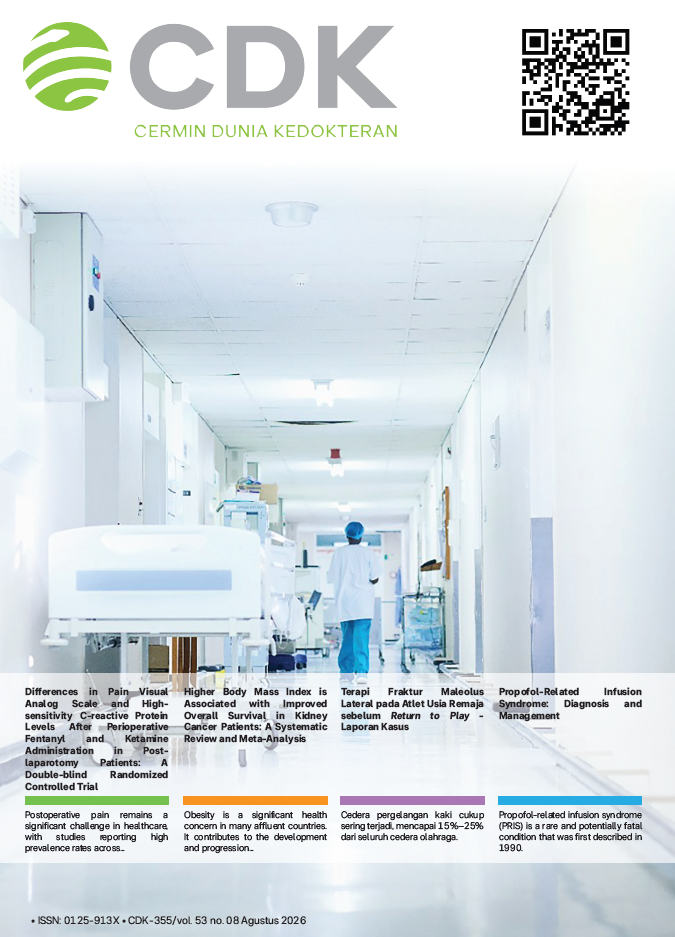
Differences in Pain Visual Analog Scale and High-sensitivity C-reactive Protein Levels After Perioperative Fentanyl and Ketamine Administration in Post-laparotomy Patients: A Double-blind Randomized Controlled Trial
Research
DOI:
https://doi.org/10.55175/cdk.v53i08.1783Keywords:
Fentanyl, high-sensitivity C-reactive protein, ketamine, laparotomy, postoperative painAbstract
Introduction: Postoperative pain remains a significant challenge in perioperative management. This study aims to analyze the differences in pain scores using the visual analog scale (VAS) and high-sensitivity C-reactive protein (hsCRP) levels between perioperative ketamine administration and perioperative fentanyl administration in post-laparotomy patients. Methods: A double-blind randomized controlled trial was conducted on 24 laparotomy patients divided into ketamine (n = 12) and fentanyl (n = 12) groups. The ketamine group received a 0.2 mg/kg bolus followed by a 0.1 mg/kg/hour infusion, while the fentanyl group received a 0.5 mcg/kg/hour infusion during surgery; drug administration was stopped immediately after extubation. VAS scores were assessed at 4 and 8 hours postoperatively, and hsCRP levels were measured preoperatively and 6 hours postoperatively. Statistical analysis used independent t-tests, Mann-Whitney U tests, and Pearson correlation. Results: The ketamine group showed significantly lower VAS scores at 4 hours postoperatively (2.92 vs 5.25; p = 0.017), but no significant difference at 8 hours (6.00 vs 5.75; p = 0.514). Postoperative hsCRP levels were lower in the ketamine group compared to fentanyl (4.58 vs 7.77; p = 0.006). A positive correlation was found between increased VAS scores and elevated hsCRP (r = 0.566; p = 0.004). Conclusion: Ketamine provides significantly superior early postoperative analgesia and more effectively suppresses the acute inflammatory response than fentanyl. However, its analgesic advantage diminishes by 8 hours, indicating the need for a multimodal strategy for sustained postoperative pain management.
Downloads
References
Mwaka G, Thikra S, Mung’ayi V. The prevalence of postoperative pain in the first 48 hours following day surgery at a tertiary hospital in Nairobi. Afr Health Sci. 2013;13(3):768–76. https://doi.org/10.4314/ahs.v13i3.36.
Ndebea AS, van den Heuvel SAS, Temu R, Kaino MM, van Boekel RLM, Steegers MAH. Prevalence and risk factors for acute postoperative pain after elective orthopedic and general surgery at a tertiary referral hospital in Tanzania. J Pain Res. 2020;13(1):3005–11. https://doi.org/10.2147/JPR.S258954.
Cheung CK, Adeola JO, Beutler SS, Urman RD. Postoperative pain management in enhanced recovery pathways. J Pain Res. 2022;15(1):123–35. https://doi.org/10.2147/JPR.S231774.
Brinck EC, Tiippana E, Heesen M, Bell RF, Straube S, Moore RA, et al. Perioperative intravenous ketamine for acute postoperative pain in adults. Cochrane database Syst Rev. 2018;12(12):CD012033. https://doi.org/10.1002/14651858.CD012033.pub4.
Doan LV, Li A, Brake L, Ok D, Jee HJ, Park H, et al. Single-dose of postoperative ketamine for postoperative pain after mastectomy: a pilot randomized controlled trial. J Pain Res. 2023;16(1):881–92. https://doi.org/10.2147/JPR.S389564.
Zhou D, Liu F, Jiang F, Ye X, Gong X, Zhang M. Sub-anesthesia dose of s-ketamine reduces postoperative pain and anxiety in patients receiving breast and thyroid surgery: a randomized, controlled trial. Pain Physician. 2023;26(3):257–64. https://doi.org/10.36076/ppj.2023/26/257.
Jouguelet-Lacoste J, La Colla L, Schilling D, Chelly JE. The use of intravenous infusion or single dose of low-dose ketamine for postoperative analgesia: a review of the current literature. Pain Med. 2015;16(2):383–403. https://doi.org/10.1111/pme.12619.
Gumelar W, Hamzah H, Sumartono C. The effectiveness of intraoperative ketamine and fentanyl as preemptive analgesia with qNOX score. J Anestesiol Indones. 2021;13(2):67–77. https://doi.org/10.14710/jai.v13i2.31900.
Yılmaz M, Kudu E, Sanri E, Karacabey S, Akoglu H, Denizbasi A. Comparison of the analgesic effects of low-dose ketamine versus fentanyl in patients with long bone fractures in the emergency department: a prospective observational study. Cureus 2023;15(10):e46344. https://doi.org/10.7759/cureus.46344.
Sleigh J, Harvey M, Voss L, Denny B. Ketamine – more mechanisms of action than just NMDA blockade. Trends Anaesth Crit Care. 2014;4(2–3):76–81. https://doi.org/10.1016/j.tacc.2014.03.002
Nichols KA, Paciullo CA. Subdissociative ketamine use in the emergency department. Adv Emerg Nurs J. 2019;41(1):15–22. https://doi.org/10.1097/TME.0000000000000222.
Zhang J, Ma Q, Li W, Li X, Chen X. S-ketamine attenuates inflammatory effect and modulates the immune response in patients undergoing modified radical mastectomy: A prospective randomized controlled trial. Front Pharmacol. 2023;14(1):1128924. https://doi.org/10.3389/fphar.2023.1128924.
Bayable SD, Melesse DY, Lema GF, Ahmed SA. Perioperative management of patients with asthma during elective surgery: a systematic review. Ann Med Surg. 2021;70:102874. https://doi.org/10.1016/j.amsu.2021.102874.
Altirkistani BA, Ashqar AA, Bahathiq DM, Bougis SM, Aljabri AM, Hanafi S. The effectiveness of ketamine versus opioids in patients with acute pain in the emergency department: a systematic review and meta-analysis. Cureus 2023;15(3):e36250. https://doi.org/10.7759/cureus.36250.
Hashimoto K, Tsuji A, Takenaka S, Ohmura A, Ueki R, Noma H, et al. C-reactive protein level on postoperative day one is associated with chronic postsurgical pain after mastectomy. Anesthesiol Pain Med. 2018;8(4):e79331. https://doi.org/10.5812/aapm.79331.
Downloads
Published
How to Cite
Issue
Section
License
Copyright (c) 2026 Adiptya Cahya Mahendra, Muhammad Husni Thamrin, Bambang Novianto Putro, Dykall Naf’an Dzikri

This work is licensed under a Creative Commons Attribution-NonCommercial 4.0 International License.